
Six Tactics to Boost Local SEO for Small Businesses
If someone needs a plumber, a café or a hairdresser…
Working together to go further.

Search visibility works like a football league with three twists: fantasy football scoring, rules that change mid-season, and no fixture list to tell you when the season ends.
The brands that win play it that way, building a squad for the long run rather than chasing a single result.
“Media buying agency UK” is one division, “how much does radio advertising cost” is another, and “marketing to over-50s” is a third. Each has its own leaders and its own relegation zone.
Most businesses aren’t trying to win the Premier League. A regional plumber doesn’t need to outrank Wikipedia; it needs to top the table for “emergency plumber Leeds”. Deciding which leagues to enter is the first big call, and most businesses make it by accident.
The divisions are more crowded than they look, too. Alongside your direct competitors, you’re up against marketplaces, review sites, Reddit threads, YouTube videos and, more and more often, an AI-written answer sitting above all of them.
There’s no official table to check. Results shift with location, device and search history, so every fan sees a slightly different one, and the only way to know where you stand is to track it.
In a real league, only results earn points. Search works more like fantasy football, where points come from everything that happens on the pitch: goals, assists, clean sheets, even just turning up. But Google keeps the scoring sheet to itself, and the AI platforms tell you even less.
| Fantasy football | SEO | GEO |
|---|---|---|
| Goals | Content that answers the search | Content clear enough to be quoted |
| Assists | Links from other sites that set you up | Other sources naming you |
| Clean sheets | No technical errors conceded | Pages AI tools can read |
| Appearance points | Turning up regularly with fresh content | Up-to-date facts |
| Bonus points | Reputation, judged by a system you can’t fully see | Brand mentions across trusted sources |
| Cards and own goals | Spam penalties, or self-inflicted errors like a botched site move | Claims that can’t be verified |
That’s why one-tactic strategies stall. The best fantasy picks score in several ways every week; a striker who only nets the odd goal ends up on the bench. Websites work the same way: links won’t carry slow, thin pages that keep conceding errors.
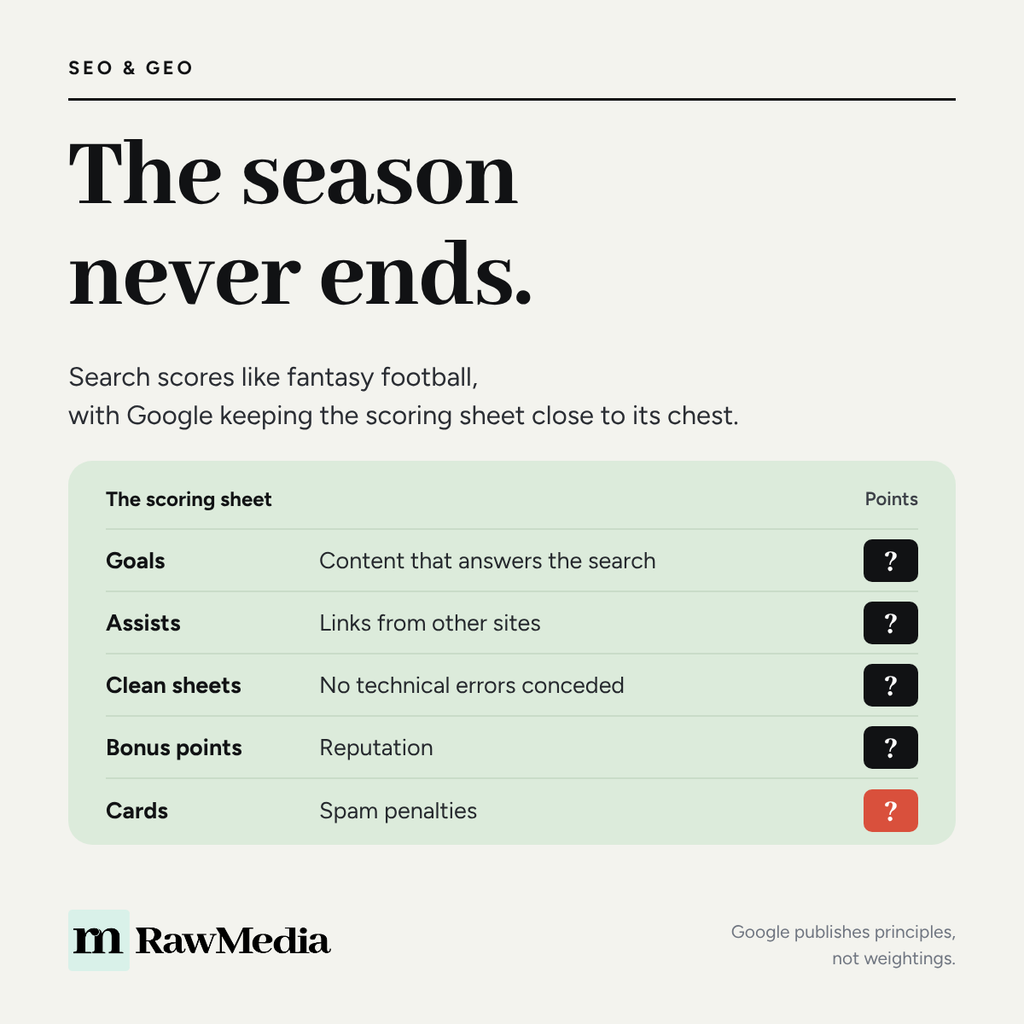
Football changes its rules between seasons, with plenty of warning: VAR and the end of away goals were argued over for years. Search changes its rules mid-season, all the time. Google has confirmed two broad core updates so far in 2026 (March and May) and four spam updates, the latest starting on 24 September (Coalition Technologies).
And those are just the updates Google announces. It says it made 4,781 changes to Search in 2023, out of more than 700,000 experiments (Google). That works out to roughly 13 changes to Search per day of the season.
When a big update lands, Google tells you it’s happening, but not what’s in it. It publishes principles rather than weightings, so you work out the new rules by watching how the table moves after each round of fixtures.
A football season has 38 fixtures and a final whistle. In search the season just keeps going, and the table never freezes long enough for anyone to lift a trophy, so SEO is never “done”.
That changes how you should read the table. Your overall position matters less than your form: are you gaining or dropping points over the last few months? A club top in May can be mid-table by autumn if it stops playing.
Last season’s points don’t carry over, either. Football resets the table once a year; search chips away at your points all the time. Content ages, links break, competitors publish better answers, and AI tools favour current information. Stand still, and you drift down the table, slowly enough that it’s easy to miss.
GEO (generative engine optimisation) works differently. Ask Google’s AI Overviews or AI Mode, ChatGPT or Perplexity a question and you get a written answer that names a handful of sources. That’s closer to a pundit’s team of the week than a league table: you’re either picked or left out, with no first or tenth place.
And every pundit picks a different team. Each AI tool draws on different sources, and asking the same question twice can change the picks. Getting picked depends less on one great performance than on being talked about in the right places: reviews, press, forums, and your own clear, quotable pages.
AI search already draws a huge crowd. Google says AI Mode passed 1 billion monthly users by July 2026 (Google). And when an AI summary appears, people click less: in a US study by Pew Research, users clicked a traditional result on 8% of visits with a summary, against 15% without. They clicked a link inside the summary just 1% of the time (Pew Research Center).
So the two competitions score differently. SEO pays out on the click. GEO pays out on the mention, which may never turn into a visit but can decide who makes the shortlist. A brand can sit top of the table and still be left out of the team of the week.
This is where search is less fair than football. Google writes the rules, referees the matches and fields its own team: when its AI answers appear, they sit above every organic result and compete for the same attention.
The clubs that last build squads that can score whatever the rulebook says.
With no end date, there’s no trophy to lift, just a position you keep earning, round after round, in the leagues where your customers search.
Sources